Sunday, February 28, 2016

Sunday Paper: Reeves Laid to Rest

Part 2: 14 Nov 1880


On 14 November 1880, a quick story in the Daily Appeal noted that Meredith Reeves was buried the day before.


Reading this from a 2016 perspective, it's interesting that the paper gives no presumption of innocence. Granted, Monroe never denied killing Reeves; he said it was self defense. Either way, a modern reporter would never be this bold. Instead he'd likely be listed as the "accused killer" - especially four months before the case even sees trial.

Also of note: A quick review of the Elmwood Cemetery Daily Burial Record (1853-1919) shows that Meredith Reeves was indeed interred at Elmwood, in the Chapel Hill section. That's not too far from where Monroe Klinck spends his eternity.

The stick shown in the Left Center marks Reeves' grave. Special thanks to the Elmwood Cemetery staff
and to Wanda and John D. Klinck for their investigative and photography services.

Read Part One: 10 Nov 1880

Thursday, September 25, 2014

Captain Hayne Klinck Headstone Dedication Ceremony - Part 2

On 9 August 2014, a group of Captain Hayne Klinck's descendants and friends gathered alongside Sons of Confederate Veterans, and United Daughters of the Confederacy to dedicate his brand new headstone. Enjoy these photographs taken following the ceremony.

We were most thankful not only for the large Klinck family turnout, but also for the relatives from other branches of our family tree (Graces, Ferrers), family friends (Goldsmiths, Epsteins), and strangers who took the time to honor our ancestor beside us! Special thanks also go to Mr. Larry Epstein, who took the fantastic photographs shown here.

Related links:
Captain Hayne Klinck Headstone Dedication Ceremony - Part 1
2014 Eulogy of Captain Hayne Klinck 
SCV: N.B. Forrest Camp 215 
52nd Regimental String Band 
United Daughters of the Confederacy


United Daughters of the Confederacy member Anita Cornell in her beautiful widow's weeds.

Anita Cornell (UDC)

Ms. Cornell places flowers on Captain Klinck's grave

Sons of Confederate Veterans: Lee Miller, Mick Daugherty, Dave Eason, Michael Wyatt, Mark Buchanan, Ken Crestman

Hayne's grand nephews, Claude and Paul Klinck

Mourner Dore Dorris (UDC)

Rachel and Debbie Klinck

Joe, Kristin, and Ben Klinck

Pat Chaney and Maggie Grace Murphy

Wendy (Ferrer), John, and Robert Rylee

Joyce Klinck, Jeff Goldsmith, and Donna Cody

Despite over three years working with the fantastic Knox Martin on headstone ceremonies and research projects, this is the only photo of Kristin Klinck Petersen and Knox. Guess we'll have to do another!

SCV and UDC members with Klinck family from L to R: Joe Klinck, Ashley Klinck, Rachel Klinck, ,Joyce Mariencheck Klinck, Kristin Klinck Petersen, Debbie Klinck, Paul Klinck, Donna Klinck, Claude Klinck, Sarah Klinck, Ellie Klinck, Bobbie Klinck, Ben Klinck

Wednesday, August 27, 2014

Captain Hayne Klinck Headstone Dedication Ceremony - Part 1


On 9 August 2014, a group of Captain Hayne Klinck's descendants and family friends gathered alongside Sons of Confederate Veterans, and United Daughters of the Confederacy to dedicate his brand new headstone. The following photos document the ceremony itself. Visit again for Part 2 for additional candids.

Related Links:
2014 Eulogy of Captain Hayne Klinck 
SCV: N.B. Forrest Camp 215 
52nd Regimental String Band

After 150 years, Captain Klinck finally has a headstone!
Special thanks to the great people at Crone Memorials.

Captain Klinck's stone with flags and flowers for the ceremony.

Tennessee State Genealogist for the Sons of Confederate Veterans, Knox Martin, acted as emcee. Knox has been instrumental in helping us secure headstones for our Confederate ancestors. This is also the second dedication ceremony he's set up for us.
Knox gives the opening remarks.

Knox explains the 154th Senior Tennessee Regiment flag.

SCV Color Guard

Kristin Klinck Petersen reads Captain Klinck's eulogy.

To read a transcript of the eulogy, which tells what is currently known about Captain Kinck's life, click here.

Lee Miller and Dave Eason of the 52nd Regimental String Band sing period tunes including, of course, Dixie!


Musket salute!


Mick Daughtry (center) takes aim during the musket salute.


2nd great grand niece, Kristin Klinck Petersen, fires a parting shot over the grave.

Mick Daughtry completes the Last Canteen Ceremony. During this ceremony, the guard recalls that soldiers were often deprived of necessities like uniforms, shoes, and food and water - so they shared everything they had with one another. Each Color Guard member sips water from the same canteen before the rest is poured on the grave of the fallen soldier.


Dave Eason leads the crowd in prayer.

Thursday, August 14, 2014

2014 Eulogy of Captain Hayne Klinck

November 30, 2014 marks the 150th anniversary of the death of Captain Hayne Klinck during the battle of Franklin. On August 9, 2014, we honored Captain Klinck by dedicating his new headstone at Elmwood Cemetery in Memphis. The following eulogy was written and read by his 2 x great grand niece, Kristin Klinck Petersen.

Son

Hayne Irby Klinck was the second born and eldest son of John Graham Klinck and Sarah Henderson Irby.  Born in his mother’s home town of Laurens, SC in 1835, Hayne soon moved with his family to Memphis where he spent the rest of his life until the outbreak of the Civil War.

Husband & Father

At 21, he married Margaret Ann Robertson. Their daughter, Emma, was born two years later, in 1856. Four years after that, a son, whom they called John Graham Klinck, Jr, was born in 1860. Sadly, John was one of the city’s many yellow fever victims: he succumbed in 1873 when he was only 13 years old.

Police Officer

When he was 25, Hayne was nominated to the Day Police by the Memphis City Council. He spent several very busy years protecting the city, mostly with his partner, John Dyer. During their tenure together, Klinck & Dyer rid the streets of counterfeiters, dray-tipping ruffians, abolitionists, and even garroters! In 1861 he was elected as Captain of the Day Police, a title he held until the city fell to the Union.
See Dixie Roots Series, Hayne Klinck: Super Cop

Tennessee Marriage License for Hayne Klinck and Mary Robertson

Detective

The next chapter of Hayne’s life is arguably the most intriguing and exciting. Unfortunately, it’s also the story I’m the least confident in retelling – especially standing over his grave! So I’ll tell you what I think I know …

About a year ago, ironically while looking for records on someone else, I tripped into a treasure trove of documentation on Hayne’s role as a special agent for the Confederacy. The 50+ pages of payment invoices and letters offer a very rare glimpse into the almost daily life of a Confederate agent.

In September of 1862, Hayne was a member of a guerilla band that captured Uniontown, KY. They overtook the 43rd Indiana Regiment, sacked the town, captured at least 200 muskets, and commandeered a steamer! Reportedly, in addition to burning the ship’s 200 bales of cotton, the Rebels also “confiscated the contents of the bar.”

Unfortunately, the fun ended there. Not long after, Hayne was captured and sent to the notoriously grotesque Union military prison in Alton, Illinois. There, overcrowding, poor nutrition, harsh weather, and inadequate clothing led to dysentery, pneumonia, small pox, and rubella.
See Dixie Roots post, Aiding and Abetting the Rebels

Thankfully, by March of 1863, he was free and had made the journey to the capital of the Confederacy in Richmond, VA. There, he was assigned to special service under Major General Arnold Elzey. See Dixie Roots post, Assigned to Elzey
Payment records show he was paid $4/day for un-specified “special services” rendered over the next six months, mostly in Richmond. In September, however, Hayne wrote a letter to his superiors from Charleston explaining difficulty he had carrying out his duty. His mission seems to have been to round up and arrest draft dodgers, however local city police did not recognize his authority to do so and threatened to bring his actions to the attention of the mayor. Hayne wrote,

“As we have no military prison, an order should be delivered to the mayor to receive all prisoners arrested by myself or any other authorized officer or agent of yours. I have not and will not … violate any civil law, but it seems to be the opinion of the mayor and all civil officers that no citizen should be arrested by any military officer. I have noticed in all places there are sure to arise some little jealousies between government and civil officials. This I have always avoided and never had any trouble or misunderstanding until now.”
Copy of Page 2 of Hayne's letter dated  4 September 1863

A few months later, in December of 1863, Hayne wrote to his superiors again, this time asking for permission to leave Charleston for a few days to travel through Georgia. He requested that Captain E. Pliny Bryan escort him and that he be granted transportation and a sum of $600. Although I haven’t been able to research this mission yet, there are a few standout points to the story.

First, his request was written on December 19th. According to the invoices, it was approved and the check was cut on the very same day! Second, the man Klinck requested to accompany him, Pliny Bryan, was no slouch. An army officer and state legislator before the war, Bryan became fairly-well known as a Confederate spy, constantly dipping into and out of enemy territory for intelligence, reporting on troop movements and river traffic, and even successfully blowing up two boats. A letter to Jefferson Davis about his intelligence-gathering called him, “bold and intelligent and well worthy of any recognition reward you may deem suitable.” The request for Bryan to accompany Klinck was also granted. As was the $600 – almost 6 months of Klinck’s salary – or, according to one inflation calculator – about $11,000 today!

My current records show nothing more about this mission.
The last major event in my special service records is the most compelling, but also the bit I know the least about. So I’ll simply read you Hayne’s desperate letter from Charleston, dated March 11, 1864:

Copy of original letter

Transcript of original letter

Although I don’t yet know how he came to be arrested, how long he was imprisoned, or what circumstances lead to his release, by late May, high-ranking Confederates and lawmakers begin writing letters to congress requesting his immediate promotion. A quote from one of the letters is on your ceremony cards. It reads in full:

“Mr. H.I. Klinck, a citizen of Tennessee and a skillful policeman in the city of Memphis, has been in the service of the Confederate States as a detective from the beginning of the war. Mr. Klinck has been faithful in the discharge of his duties and has displayed skill, courage, and ability as a detective. Being cut off from his home by the invasion of the enemy’s occupancy, Mr. Klinck and his family are totally dependent on his office for support.”

His promotion was granted and a raise to $5/day was instilled – including back pay to the beginning of 1864.

Soldier

The short time left to Hayne is a bit of a mystery. His special service records end with the documentation on his promotion. What remains we learned from witness testimony given in support of his widow, Margaret’s, pension application.

The first witness, Senator Thomas B.Turley (whom a section of this cemetery is named for), reported that he remembers first seeing Klinck around the first of November in Florence, Alabama. He testified that,

“While the [154th Senior Tennessee] Regiment was camping at Florence Alabama, a man named Klinck who was a tall man with dark hair and was well built, but not fleshy, joined the regiment as a private. He remembers that a good many of the members of the regiment recognized Klinck and seemed well acquainted with him … Turley remembers because it created considerable comment that a man from Memphis should come to the regiment that late in the war and join as a private.”

The second witness testimony comes from J.R. Flippin, quartermaster of the 154th In addition to remembering that Klinck joined up only a few weeks before the Battle of Franklin, Flippin reported speaking to Klinck, saying:

"Klinck thought that while [I] was acting quartermaster, I would be much less likely to be killed than any member of the command engaged in active hostilities.”

He was right. While Flippin survived, neither Hayne nor his new regiment fared well in this battle. If he was sent to the front line as he feared, Klinck was likely part of Major General Patrick Cleburne’s division, which fought in the heat of the battle and advanced into the enemy works. Not only was Cleburne himself one of the five generals killed at Franklin, but his division suffered the largest percentage of casualties of any of the Confederate units in the battle. They entered the field with 3,500 men and lost 1,540.

Flippin recalled the rest of their conversation:

“A short time before the battle of Franklin, Klinck came to [me] impressed with a presentiment that he might not survive the engagement. He entrusted [me] with a fine gold watch, a diamond ring, and some money, consisting of gold, green-backs, and Tennessee bills. .. He entrusted me to take them, should he be killed, to the city of Memphis and deliver them to his widow.”
Witness testimony of J.R. Flippin

Although it’s unclear what circumstances caused Hayne to vacate his position as a special services detective and join a regiment as a private, his final request shows one thing quite clearly: As Captain Klinck – a man of not yet 30 who had spent his entire adult life in the service of his city and his country - approached what he knew would be his certain death on the front lines of battle, the well-being of his family was first on his mind.

Related Links:
Captain Hayne Klinck Headstone Dedication Ceremony - Part 1
Captain Hayne Klinck Headstone Dedication Ceremony - Part 2

E. Pliny Bryan Sources: 


Tuesday, August 6, 2013

Tombstone Tuesday

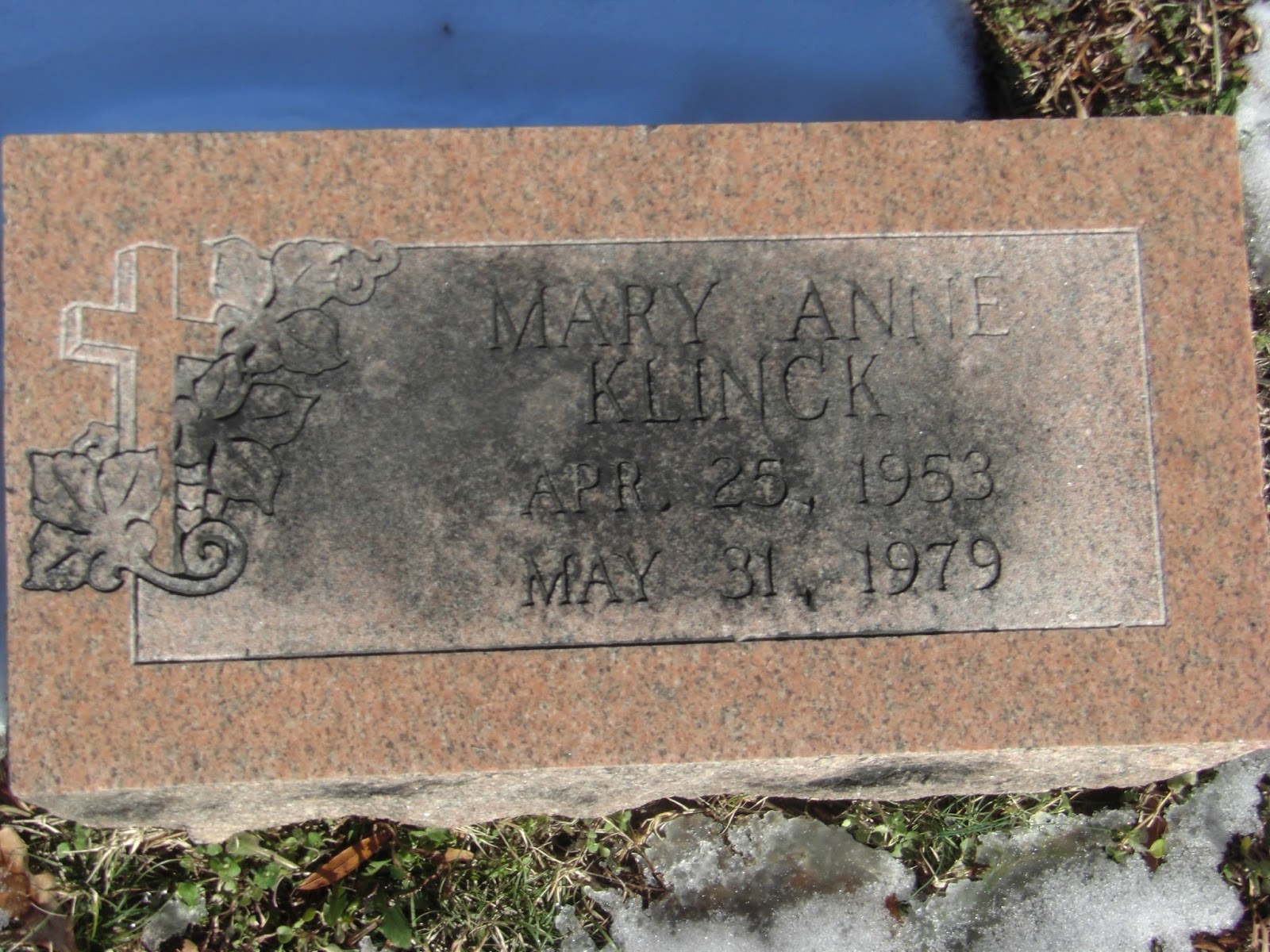
Mary Anne Klinck

Mary Anne Klinck was born to Merrill Klinck and Rita Wilson in 1953. Her birth was uncomplicated; there were no medical issues to speak of. For two years, she was an average, happy, smiling, precocious baby girl. Then, as she approached her third birthday, she contracted the measles. Unfortunately, her bout of the measles was complicated.  It had a major effect on her brain, which eventually led to Cerebral Palsy.  One week she was walking and talking – the next she was totally incapacitated. She couldn’t walk, talk, or control her body in any way.


Merrill and Rita did all that they could to help their daughter. They met with neurologists, brain surgeons, and even flew to Baltimore to see a specialist. But in the 1950s, there was little that could be done to appease the nature of her disorder.  So instead, they did all that they could to create a loving, interactive, and social life for her.
They taught her to communicate by showing her how to raise her hand for “Yes!” According to family, if you were asking questions about something she was excited about, she could shoot her arm straight up over her head! She loved to have books read to her and to watch television. And she also loved the social activities she participated in outside her home with other CP kids through organizations like UCP and Les Passes.

When Mary Anne reached her twenties, her health began to seriously decline. She began having major organ problems, fluid on her lungs wouldn’t allow her to sit up, and she temporarily lost her sight. In May of 1979, Mary Anne died peacefully in her sleep. She was 26 years old.

To read about the very interesting history of Les Passes, visit their website.
Buddy and Butch work on a chair in front of the garage,
742 Baltic, Memphis.
Fun fact:
The lightweight, ergonomic wheelchairs you see today did not exist in the 1950s when Mary Anne needed one. Most families were left to fend for themselves when it came to the transport of their handicapped children.
Luckily, a family friend was able to help.
Merrill and Rita knew Buddy and Dell Mariencheck through their mutual friends, the McCarthys. Buddy built chairs not only for his son, Tom, who also had CP, but for countless other children.
Buddy and his friend Vince "Butch" Brunner designed chairs based on the individual needs and physical abilities of each child. They made at least two chairs for Mary Anne, one of which was a "potty" chair. The seat featured a removable panel that could be slid out, a bedpan moved in, and then removed again.
A few years later, Mary Anne's older brother Paul married Buddy and Dell's daughter, Joyce. And we all sing, "It's a small world after all ..."
Personal Data Tombstone Data
Birth: 25 Apr 1953 City: Memphis, TN
Marriage: N/A Cemetery: Calvary
Death: 31 May 1979 Section:
GPS:


Tuesday, July 9, 2013

Tombstone Tuesday

John Hayne
"Jack" Klinck


Jack Klinck was the second-born child of James Monroe Klinck and Annie Littleton. In 1905, he began by following in his uncle (and namesake) Hayne's footsteps and working for the Memphis Police Department. He held various positions with the MPD until 1918, when he worked as a detective for the attorney general. In about 1922 he hung a shingle (literally, see photo at right) as a justice of the peace. He held the position until his sudden death from a heart attack at age 52. 
1922 photo of J.H. Klinck's office in the area of North 2nd & 3rd Streets & Adams and Washington Avenues
(photo courtesy of Tennessee State Library and Archives)


Personal Data Tombstone Data
Birth: 2 Oct 1877 City: Memphis, TN
Marriage: 12 Sep 1911 to Lillian L. Williamson Cemetery: Elmwood
Death: 9 May 1930 Section:
GPS:


Tuesday, June 18, 2013

Tombstone Tuesday

Irby Eugene Klinck

Irby Eugene Klinck was the middle son of Memphis Chief Irby Monroe Klinck and Ella Cushing. He met Gertrude Maxey at the Malone Park swimming pool, where he was a lifeguard; they married in 1932 when he was 19 years old. They had a daughter, Beverly, but the marriage was not meant to be and they soon divorced. In 1942 he married again, this time to Mary “Jackie” Nolan. They were together until Irby’s death in 1982.

During World War II, Irby was a technician in the U.S. Army Medical Corps, serving primarily in Italy.  He continued to struggle with alcohol for the rest of his life. 

A bit of mystery surrounds Irby's names. In almost every record we have (including his headstone), he is listed as "Irby E. Klinck, Jr."  However, his father's middle name is Monroe - not Eugene. Perhaps since his dad was so well known in town, it was easier to distinguish between them by tacking on the "jr.." Then there's his nickname. Everyone called Irby "Piggie." Irby called his brother, Merrill, "Nook." No one living knows the origin of either nickname. All we know, is that they stuck!

We do know the origin of his first name. His great great grandfather was South Carolina plantation owner William Carter Irby.

Side note:
Admittedly, we’re making a bit of a presumed connection between Irby’s relationship with alcohol and his wartime experiences. But it’s not a wild one. The modern understanding and acceptance of PTSD did not exist when WW2 veterans began coming home. For an interesting look at the treatment of PTSD and other psychological challenges during WW2 (which sometimes included dispensing liquor to soldiers), visit the History of PTSD blog.
Inscription: "To Nook and Rita with love, Pig"


Personal Data Tombstone Data
Birth: 13 Jul 1913 City: Memphis, TN
Marriage: 1 Aug 1932 to Gertrude Maxey
28 May 1942 to Jackie Nolan
Cemetery: Calvary
Death: 23 Nov 1982 Section:
GPS:


TEC5, or "Technician"  was Irby's rank in the Army Medical Corps

Tuesday, May 28, 2013

Tombstone Tuesday

Irby Monroe Klinck
Irby Monroe Klinck is the youngest son of James Monroe Klinck and Annie Littleton. He started working at age 15 as a telephone operator. At age 18 he brushed elbows with King Cotton, working for the hoop manufacturer, Patterson, Busby & Co. Finally, in 1905 he found his calling; beginning as a driver for Hook & Ladder Co. no 2. He spent the next 25 years honing his skills and rising through the ranks of the Memphis Fire Department.

He became a captain in 1910, assistant chief in 1924 and chief in 1933. While Irby was chief, Memphis won the National Fire Waste Council’s award for the best fire prevention program in the United States multiple times over. The second year he was chief, Memphis had the lowest fire loss in 37 years, despite its growth.
Chief Klinck at his desk. This photograph always sat on my grandfather Merrill Klinck's chest of drawers.

For more information on the Memphis Fire Department, visit the Fire Museum of Memphis.


Personal Data Tombstone Data
Birth: 31Jan1882 City: Memphis, TN
Marriage: 21Feb1907 to Ella Cushing Cemetery: Calvary
Death: 22March1944 Section:
GPS:


Thursday, May 2, 2013

Klinck & Grader: Together on Paper


This document shows the distribution of almost $6,000 to various individuals (including one woman!) in May, 1862. Memphis is scratched out for Columbus, Mississippi. Such edits are seen on Many of these documents.

Some significant discoveries have been made in the past week regarding the Civil War service of our ancestors. With luck (and more research), it will lead to more VA-supplied headstones. Cross all fingers and toes!

While documents are analyzed, transcribed, and restored, I wanted to share this historic document. It reveals two things we've never seen before:
  1. Proof that John Graham Klinck (typically signed "JG Klinck") was an Ordnance Officer for the Confederacy.
  2. Further proof that George W. Grader, John Klinck's son-in-law, was a fellow Ordnance Officer, as seen by both of their signatures on this document.

You can also see the stamp of the CSA Archive office. The oval stamp reads, "Record Division, War Department. Rebel Archives." Awesome!
At left, George W. Grader. Highlighted at right are both men's signatures.

Monday, March 4, 2013

Klinck Arrests Abolitionist

On 20 April 1861, ancestor Hayne Klinck and his partner, Dyer arrested a suspected abolitionist named Thomas Pearce. From a modern perspective, it might seem shocking that one could be arrested for a political stance - but in pre-Civil War Memphis, the police saw an abolitionist as one who intended to steal valuable property.

With the passing of the Fugitive Slave Act of 1850 (passed by the United States Congress on 18Sep1850), runaway slaves were to be returned to their masters upon capture. Because runaway slaves were considered criminals, those who promoted or aided in their release were also implicit in the crime. Distributing anti-slavery propaganda like the sign below was a serious crime that could carry a serious punishment.

For further illustration, search the 1858-1860 index of the Memphis Police Blotter using the keyword slave. Memphis law enforcement spent a goodly amount of time rounding up slaves and checking their credentials.

Memphis Daily Appeal, 20 April 1861

Abolitionist propeganda courtesy of AmericanPeopleII.

Friday, February 15, 2013

Klinck Arrests Garroters

In April of 1861, (Hayne) Klinck and Dyer once again brought down the heavy hand of the law on the miscreants of Memphis. Only this time, their arrest probably saved lives! After two garroters named Hughes and Mack were sentenced to nine years imprisonment, they decided to sing, giving up their ring leader, Deal. A man named George Fairbanks was also removed from the streets.

But wait … GARROTERS?!  While Memphis certainly had its fair share of violent criminals in its antebellum days, “bands of garroters” were certainly not highlighted in my 7th grade Tennessee State History textbook.  And garroting, or strangling one from behind, typically during a robbery, is just so … intimate. Yuck!

While there are no garroting or strangulation statistics for 1860 Memphis, there are many resources about this particular murder method for Victorian-era London. It fact, garroting was so popular, it sparked the London Garroting Panic of 1862. Although many reports indicate that the panic was mostly hype, it did spark the invention of several anti-garroting devices … and several farces, both of which I’ve shared here.

"EFFECT OF THE ANTIGAROTTE COLLAR ON A GARROTTEUR."
Punch, 27 Sep 1856


Special thanks to British author Lee Jackson from The Dictionary of Victorian London, who graciously shared the garroting images. Also thanks to Robert Wilhelm from Murder by Gaslight. Check out his site dedicated to 19th century American murders – it’s a ghastly good time!
Do You Wish to Avoid Being Strangled?!
If so, try our Patent Antigarotte Collar, which enables Gentlemen to walk the streets of London in perfect safety at all hours of the day or night.
THESE UNIQUE ARTICLES OF DRESS
Are made to measure, of the hardest steel, and are warranted to withstand the grip of
THE MOST MUSCULAR RUFFIAN IN THE METROPOLIS,
Who would get black in the face himself before he could make the slightest impression upon his intended victim. They are highly polished and
Elegantly Studded with the Sharpest Spikes,
Thus combining a most recherché appearance with perfect protection from the murderous attacks which occur every day in the most frequented thoroughfares. Price 7s. 6d, or six for 40s.
WHITE, CHOKER, AND Co.

"EFFECT OF THE ANTIGAROTTE COLLAR ON A GARROTTEUR"
Punch, 27 Sep1856


Memphis Daily Appeal, 17 April 1861