 |
| Dell Ferrer Mariencheck seems pleased with her savings as she sits on the steps of the Ferrer home at 1038 Holmes, Memphis. |

Friday, June 23, 2017
Family Photo Friday

Monday, March 10, 2014
The Emma Ferrer Letters, Part 9: A Boy for Rev. McCoy
|
On 30 August 1899, almost one year after the previous letter, Judge
Wood writes to Emma on behalf of Reverend James H. McCoy. McCoy is
looking for a “boy” and Wood strongly encourages Emma to give her
consent for her oldest son, Olin, to accept the position. “Perhaps he
will never have another opportunity as good as this one.” Based solely upon accounts of his career, Rev. James Henry McCoy appears to have been a decent fellow. In 1899, he was a traveling Methodist minister just like George W. Ferrer. Although names and numbers vary depending upon the source, he was a married man who had several children of his own. In 1910, McCoy was ordained bishop. Five years later in the death announcement of his wife, we read that, “Her husband, Bishop McCoy is one of the most beloved men in Alabama.” Without specifications from the Alabama Children’s Home itself, it’s hard to tell what the extent of this offer is. During the 19th century, it was fairly common for wards to be indentured to foster families. This set up is a win-win for the Alabama Children’s Home. It obviously makes one less mouth to feed. Meanwhile, Olin would be with a respectable member of the church, working in exchange for food and shelter. Wood promises Emma he will “fare well in every way.” The question is – is this a fostering arrangement or an adoption? Next Week: All of My Hopes and Ambitions are Centered in Him |
||
Interesting note: The Ferrer children probably weren’t the only ones in
the home who had a living parent. According to Dale Keiger’s article,
“no more than 10 to 20 percent of the children in orphanages were actual
orphans. Most had one or two living parents who were unable (usually
due to poverty), unwilling, or had been deemed unfit to care for them.”
Between 1853 and 1929, “orphan trains” became popular. Orphaned and homeless children from crowded North Eastern cities would be loaded onto trains and shipped to the Mid-West where they could be adopted by farming families in need of extra hands. |
|
||
|
 |
||
|
 |


Sources:
- The Roanoke Leader. June 1915, Roanoke, Randolph County, Alabama, Issue of Wednesday, June 2, 1915
- Encyclopedia of Children and Childhood in History and Society
- Keiger, Dale. The Rise and Demise of the American Orphanage.
- Elmer T. Clark Portraits of Methodist Bishops at Bridwell Library, SMU, Bridwell Library, Perkins School of Theology.
Monday, March 3, 2014
The Emma Ferrer Letters, Part 8: A Very Foolish Thing
| On December 4, 1898, Emma concedes that she must put her 6-month old son, Powell Ferrer, in the orphanage with her other five children. At the time, she was working at the Grand Avenue Hotel in Meridian, MS as a housekeeper. She says the proprietor did not want her to have the baby there. It’s unclear whether she was getting someone in the hotel to watch Powell while she worked, or whether she was toting him around from room-to-room while she made her rounds. Either way it’s not a prime arrangement. The trip from Meridian, MS to Summerfield, AL covers about 110 miles, which we assume Emma and Powell made by train. At the time, there were 11 different rail lines running into the city, one of which connected to Selma, Alabama – the East Tennessee, Virginia, and Georgia Rail Road. Selma was about 9 miles South of Summerfield; we presume it’s for this last leg of the trip that she’s asking for “conveyance to the home.” |
On Railroads and Meridian: It’s fair to say that the “Golden Age of Meridian” (1890-1930) was due in large part to the city’s high concentration of railroads. The 1899 Meridian City Directory states that, “It would be almost impossible, says an authority of no mean repute, to take a map and draw a line for anew railway running out of Meridian which should not find for itself a belt of country not already fully occupied by existing roads, or roads that contracts are let out, and others that are in contemplation, so numerous are the radiating tracks of steel that enter the magic city.” |
||

Next Week: A boy for Rev. McCoy
|
 |
||
|
 |


Sources: Meridian, Mississippi, City Directory, 1899. Ancestry.com. U.S. City Directories, 1821-1989. Provo, UT, USA
Monday, February 24, 2014
The Emma Ferrer Letters, Part 7: The Battle for Bread
In a letter to Wood dated simply November, Emma writes from Meridian, MS to say she can’t bring the children until December as she’s struggling to find employment. For the first time in these letters, Emma veers from her matter-of-fact letter-writing style and turns slightly metaphorical when she admits she “find(s) the battle for bread a hard one.”
We assume she was drawn to Meridian in particular because she had family there. Her older brother, Benjamin W. Johnson, lived in Meridian with his wife Ida and their family. According to the 1900 US Census and Meridian city directories, Benjamin was in the restaurant business.
The city itself was growing into quite the metropolis. In fact, in the 1899 Meridian City Directory, they called themselves the “Metropolis of the South-West” and claim Meridian is the most prosperous city in the state of Mississippi. Bask in the hope for the future laid out in the directory's introduction:
“New England has held the fort of commercial supremacy, unmerited, long enough. She is losing her powerful grasp day after day, and the South steadily moves onward. The future before this city is brighter than we can elucidate it. All must strive with unanimity of purpose, heart, brain, hand, and money. We heartily invite mechanics, merchants, laborers, manufacturers, capitalists, men of energy, men of brain, especially men of integrity, men of enterprise, who have the manhood to undertake great works and the capacity to carry out the undertakings. Again we say, cordially, “Whoever will, let him come.”
Emma accepted their invitation. And while Rev. Rencher had doubts about her decision to move, many others clearly shared her enthusiasm. The 1899 directory lists the population in the 4,000 range. By 1904, directories are quoting a populous of over 23,000!
Next week: A very foolish thing
Sources:
We assume she was drawn to Meridian in particular because she had family there. Her older brother, Benjamin W. Johnson, lived in Meridian with his wife Ida and their family. According to the 1900 US Census and Meridian city directories, Benjamin was in the restaurant business.
 |
| Birds-eye view of Meridian from the 1899 Meridian City Directory |
The city itself was growing into quite the metropolis. In fact, in the 1899 Meridian City Directory, they called themselves the “Metropolis of the South-West” and claim Meridian is the most prosperous city in the state of Mississippi. Bask in the hope for the future laid out in the directory's introduction:
“New England has held the fort of commercial supremacy, unmerited, long enough. She is losing her powerful grasp day after day, and the South steadily moves onward. The future before this city is brighter than we can elucidate it. All must strive with unanimity of purpose, heart, brain, hand, and money. We heartily invite mechanics, merchants, laborers, manufacturers, capitalists, men of energy, men of brain, especially men of integrity, men of enterprise, who have the manhood to undertake great works and the capacity to carry out the undertakings. Again we say, cordially, “Whoever will, let him come.”
Emma accepted their invitation. And while Rev. Rencher had doubts about her decision to move, many others clearly shared her enthusiasm. The 1899 directory lists the population in the 4,000 range. By 1904, directories are quoting a populous of over 23,000!
Next week: A very foolish thing
 |
 |
- Meridian, Mississippi, City Directory, 1899. Ancestry.com. U.S. City Directories, 1821-1989. Provo, UT, USA
- Year: 1900; Census Place: Meridian Ward 4, Lauderdale, Mississippi; Roll: 815; Page: 3A; Enumeration District: 0019; FHL microfilm: 1240815.
Monday, February 17, 2014
The Emma Ferrer Letters, Part 6: Failure to Communicate
On November 5, 1898, Emma became the victim of a miscommunication. She originally only received one application, which she filled out for all six children. After mailing it, she received six more blank applications in the mail. With time of the essence, she writes to Wood imploring that the initial application be deemed acceptable.
In this letter, she also mentions that she’d traveled over 26 miles to receive the recommendation of W.T. Rencher. Between the illegible town name on Rev. Rencher’s letter and the frequency with which he moved, we’ve not been able to map the exact route Emma took to obtain his recommendation. However, knowing that a horse and rider can typically cover between 20-30 miles in one day, it’s a safe bet that Emma took at least one day away from her job hunt and from the care of her six children to visit him.
Next Week: The Battle for Bread
In this letter, she also mentions that she’d traveled over 26 miles to receive the recommendation of W.T. Rencher. Between the illegible town name on Rev. Rencher’s letter and the frequency with which he moved, we’ve not been able to map the exact route Emma took to obtain his recommendation. However, knowing that a horse and rider can typically cover between 20-30 miles in one day, it’s a safe bet that Emma took at least one day away from her job hunt and from the care of her six children to visit him.
Next Week: The Battle for Bread
 |
 |
Monday, February 10, 2014
The Emma Ferrer Letters, Part 5: A Letter of Recomendation
William Thaddeus Rencher was born in Alabama in May of 1860. When he was 20 he was ordained as a minister and began his life as a traveling preacher. Like his peer, George W. Ferrer, Rev. Rencher moved a lot. He’s seen in the annual conference minutes of the Georgia, Alabama, and Florida conferences between 1880 and 1930.
October 10, 1931, Rev. Rencher was killed tragically when he was hit by a train. According to his obituary, the 71 year old was waiting to board a train to Jacksonville when he fell from the platform. An approaching train struck him and launched him 15 feet across the platform. He succumbed to his injuries three hours later.
Next Week: Failure to communicate
|
 |
|||
|
 |


Monday, February 3, 2014
The Emma Ferrer Letters, Part 4: Over Six Months
On November 4, 1898, Emma wrote to P.G. Wood indicating that she would need over six months to get onto her feet.
So who is this P.G. Wood?
Pleasant Green Wood was born in Alabama in 1832. As a young man, he studied Morse Code and worked as a telegraph operator for the local newspaper. When he was 20, he began studying the law and was admitted to the bar in 1854. During the war, he advanced to the rank of Major; he suffered 11 wounds. In 1866 Pleasant was elected judge of Selma’s City Court, but he resigned following the passage of the Reconstruction Act (see notes below). In 1876, Governor Houston appointed Pleasant as Probate Judge, a position that he held after continuous re-elections until his death in 1901.
In addition to his official position, Judge Wood was one of the originators and promoters of the Summerfield Orphan’s Home. It was because of his role on the Executive Committee of the orphanage that he was in a position to guide the future of the Ferrer children. The writer of his obituary claims to have overheard the following conversation between two young orphan girls following Judge Wood’s death:
“Judge Wood’s death is a greater loss to us than the President,” remarked one little girl with a tremor in her voice that told how deep her feeling was. “Yes,” responded her little companion, “He is the only father we have ever known except for Mr. Stewart.”
In the weeks following his death, an article appeared in the Montgomery Advertiser titled Tribute to Late Judge. In it, a fellow member of the Alabama bar said, We honor his memory for the purity, elevation, and simplicity of his life. The kindness of his nature was shown in all he said and did. Amid his laborious duties, he found time for attention to moral obligations, public duties, private charities, and the offices of friendship. In his death, the poor and lonely have lost a friend whose purse relieved their wants, whose counsel solved their perplexities, and whose sympathies soothed their griefs.
Next Week: A letter of recommendation
So who is this P.G. Wood?
Pleasant Green Wood was born in Alabama in 1832. As a young man, he studied Morse Code and worked as a telegraph operator for the local newspaper. When he was 20, he began studying the law and was admitted to the bar in 1854. During the war, he advanced to the rank of Major; he suffered 11 wounds. In 1866 Pleasant was elected judge of Selma’s City Court, but he resigned following the passage of the Reconstruction Act (see notes below). In 1876, Governor Houston appointed Pleasant as Probate Judge, a position that he held after continuous re-elections until his death in 1901.
In addition to his official position, Judge Wood was one of the originators and promoters of the Summerfield Orphan’s Home. It was because of his role on the Executive Committee of the orphanage that he was in a position to guide the future of the Ferrer children. The writer of his obituary claims to have overheard the following conversation between two young orphan girls following Judge Wood’s death:
“Judge Wood’s death is a greater loss to us than the President,” remarked one little girl with a tremor in her voice that told how deep her feeling was. “Yes,” responded her little companion, “He is the only father we have ever known except for Mr. Stewart.”
In the weeks following his death, an article appeared in the Montgomery Advertiser titled Tribute to Late Judge. In it, a fellow member of the Alabama bar said, We honor his memory for the purity, elevation, and simplicity of his life. The kindness of his nature was shown in all he said and did. Amid his laborious duties, he found time for attention to moral obligations, public duties, private charities, and the offices of friendship. In his death, the poor and lonely have lost a friend whose purse relieved their wants, whose counsel solved their perplexities, and whose sympathies soothed their griefs.
Next Week: A letter of recommendation
 |
 |
Wood Removed from Bench
In 1867, the United States congress passed four statutes known as the Reconstruction Acts. Adherence to these acts was a requirement to be readmitted to the Union. Included in the statutes was a requirement of judges to use tax-paying citizens in juries –including African Americans. Judge Wood argued that this went against the constitution and laws of the state of Alabama and refused to comply. According to his obituary, a “file of United States soldiers” marched into his court room and removed him from the bench. While time may cast a new light on such an action, at the time, many respected Wood’s drive to stand up to carpetbaggers.Sources:
- Pleasant Green Wood. From BROWN, BURT, ABNEY, WATTS, and Related Families
- Judge P.G. Wood Dead. Montgomery Advertiser. September 24, 1901, Volume: LXXII, Issue: 224, Page: 3
- Tribute to Late Judge Resolutions on Death of Hon. P. G. Wood. Montgomery Advertiser. October 3, 1901,Volume: LXXII, Issue: 233, Page: 3
Monday, January 27, 2014
The Emma Ferrer Letters, Part 3: The Application
The application Emma completed for her children to be placed in the Alabama Methodist Orphanage offers much in the way of genealogical proof. In addition to the years of each child's birth, the full name of their mother and father is also included. We also learn that the children's grandmother (presumably Emma's mother, Mary E. Johnson) is still living, but unable to support them. Sadly, on the line for Value of orphan's property , present or perspective, Emma wrote, nothing.
Next Week: Emma needs more than six months.

| On the Alabama Methodist Orphanage: In January of 1890, the Methodist Episcopal church opened the Alabama Methodist Orphanage in the old Centenary Institute building. It operated there until 1911, when it moved to Selma. |
|

Next Week: Emma needs more than six months.
Monday, January 20, 2014
The Emma Ferrer Letters, Part 2: Emma Applies for a Matron Position
The first letter in the collection is dated October 31, 1891 from Emma Ferrer to Judge P.G. Wood. In it, Emma reveals that she applied for a position as Matron at the orphanage, but was turned down. Although she doesn’t mention disappointment, this must’ve been a tough beginning to her job hunt. A position as matron at the home would’ve meant an income AND an unbroken family.
For a female in the 1890s, job prospects were neither desirable nor plentiful. While it seems her original intention was to raise income by taking boarders at her home, she probably began hunting for work as a maid, cook, children’s nurse, or housekeeper.
Next Week: The Application.
For a female in the 1890s, job prospects were neither desirable nor plentiful. While it seems her original intention was to raise income by taking boarders at her home, she probably began hunting for work as a maid, cook, children’s nurse, or housekeeper.
Next Week: The Application.
|
|
|
||||||
 |
||||||||


Monday, January 13, 2014
The Emma Ferrer Letters, Part 1: The Death of George W. Ferrer
| Today begins a 2-month series on the events that followed the death of George Washington Ferrer. Although his salary as a traveling preacher might’ve been sufficient for his family of 8 during his life, it did not provide for them in the event of his death. So it was, that in the fall of 1898, Emma Johnson Ferrer, herself only 30 years old, had to make the difficult decision to place her 6 children in an orphanage while she attempted to find work and save enough to provide for them on her own. Over the next few months, we’ll come to understand what the turn of the century was like for Emma and her young children through a collection of letters exchanged between Emma and the Alabama Methodist Home for Children. According to the obituary below, George began his life as a Methodist preacher in 1884, at the age of 34. In 1891 he switched to the Mississippi Conference where he remained until his death seven years later. By following the Minutes of Annual Conferences each year, we can follow George (and his family) from Whittington, MS in 1892 to Augusta, Mount Carmel, Westville, Clarksburg, and finally, Pelahatchie. His obituary appeared in both the New Orleans Christian Advocate and the Minutes of the Mississippi Conference. It was likely written by a member of his conference, as it focuses almost entirely on his spiritual life. Editorial Note: There are subtle language differences between the obituary printed in the Mississippi Conference Minutes and the New Orleans Christian Advocate. In one version, Emma "bore with (George) the hardships and privations of an itinerant preacher." In the other version, she bore these hardships "cheerfully." The New Orleans edition also includes information about the medical treatment George sought before his death: ...Friends and brethren advised him to go to Brown's Well, but there he found no relief and went on to New Orleans for treatment but he was informed that his case was beyond the reach of medical skill. Brown's Wells, located about 60 miles south of Pelahatchie, was a "health and pleasure resort built around seven wells containing large quantities of minerals" ( Lost Landmarks of Mississippi by Mary Carol Miller). The wells were thought to restore health and were frequented by many wealthy Mississippians of the time. Next Week: Emma applies for a matron position. |
|
||
|
|||


Friday, November 8, 2013

Wednesday, August 14, 2013
What's Your Name?
This fantastic photo is from Emma Johnson Ferrer's photo album (Fred Belton collection). Emma, mother of Olin, Alice, Vella, Ruth, Annie Mae, and George Ferrer (phew!), is shown seated on the left. The question is: Who is the smiling gentleman next to her holding the reigns?

What I know about the time and place:
The back of the photograph is stamped "Arlington Studios, Hot Springs, AR." That means the photo was taken between 1890 and 1948. In 1890, a man named Norman McLeod opened Happy Hollow photography studio behind the Arlington Hotel in Hot Springs. He specialized in Wild West or comical poses and printed the images on postcard stock so they could be easily mailed to loved ones. In addition, McLeod offered a wide range of sets, props, and animals (both alive and stuffed) that visitors could pose with, like the live cow pulling Emma's wagon here. Eventually, Happy Hollow expanded into an amusement part, shooting gallery, and petting zoo.
The fact that our stamp reads "Arlington Studios" helps narrow the time frame. Several resources mentioned the Happy Hollow stamp. One site said, "A picture that does not bear the name McLeod would be a disappointment to the friend to whom it was sent." However, in 1909, McLeod sold the business to David Anselberg, who ran it until 1948. If we presume that when the business changed hands, the studio stamp changed as well, we can shift our time frame to 1909 to 1948.
Finally, Emma's fashion helps shave some of the later years from the range. She's dressed similarly to our unknown ancestor in the July 31, 2013 post. Her walking skirt, bloused shirt, and fantastic shoes narrow our range to roughly 1909-1912.
What I know about the setup:
We've got Emma and a companion in a buggy pulled by a cow in front of a dilapidated cabin with a dead chicken (?) on the roof. Huh?! And what's with the sign that says, "Arkansas Traveler?!"
What about the mystery man?
We believe Emma had four brothers, all of whom would have been in their mid 30s to mid 40s during our time frame. This could be a brother. But, by 1910, Emma's husband, George Ferrer, had been gone for 12 years. Perhaps this is a new gentleman companion?
Do you know who this is?
What I know about the time and place:
The back of the photograph is stamped "Arlington Studios, Hot Springs, AR." That means the photo was taken between 1890 and 1948. In 1890, a man named Norman McLeod opened Happy Hollow photography studio behind the Arlington Hotel in Hot Springs. He specialized in Wild West or comical poses and printed the images on postcard stock so they could be easily mailed to loved ones. In addition, McLeod offered a wide range of sets, props, and animals (both alive and stuffed) that visitors could pose with, like the live cow pulling Emma's wagon here. Eventually, Happy Hollow expanded into an amusement part, shooting gallery, and petting zoo.
 |
| A postcard of McLeod's establishment (courtesy Hot Springs Arkansas in Vintage Postcards, see Sources) |
The fact that our stamp reads "Arlington Studios" helps narrow the time frame. Several resources mentioned the Happy Hollow stamp. One site said, "A picture that does not bear the name McLeod would be a disappointment to the friend to whom it was sent." However, in 1909, McLeod sold the business to David Anselberg, who ran it until 1948. If we presume that when the business changed hands, the studio stamp changed as well, we can shift our time frame to 1909 to 1948.
Finally, Emma's fashion helps shave some of the later years from the range. She's dressed similarly to our unknown ancestor in the July 31, 2013 post. Her walking skirt, bloused shirt, and fantastic shoes narrow our range to roughly 1909-1912.
What I know about the setup:
We've got Emma and a companion in a buggy pulled by a cow in front of a dilapidated cabin with a dead chicken (?) on the roof. Huh?! And what's with the sign that says, "Arkansas Traveler?!"
| The Arkansas Traveler is at once a legend, a song, a painting, and a
minor league baseball team. In about 1840, Colonel Sanford Faulkner
became lost in rural Arkansas and asked for directions at a small log
cabin. He turned his experience into a song and performance that he took on the road. In the years since, several variations of the tune and of the lyrics have surfaced. In 1856, Arkansas artist Edward Payson Washbourne painted a picture illustrating the meeting between the traveler and the squatter (shown here). Like the song, several imitations and variations have cropped up over the years - including a printing by Currier & Ives in 1870. The set of Emma's photo pokes fun at the prevailing hillbilly stereotype that eventually became synonymous with The Arkansas Traveler. |
|

We believe Emma had four brothers, all of whom would have been in their mid 30s to mid 40s during our time frame. This could be a brother. But, by 1910, Emma's husband, George Ferrer, had been gone for 12 years. Perhaps this is a new gentleman companion?
Do you know who this is?
| Sources:
Hot Springs, Arkansas in Vintage Postcards, By Ray Hanley,
Steven G. Hanley, 1998
The Melting Pot Genealogy Society: Happy Hollow in Hot Springs
The Encyclopedia of Arkansas History and Culture: Arkansas Traveler
|
For Fun: To hear a fun rendition of the song The Arkansas Traveler, check out my cousin Madeleine Ferrer Donovan's blog, Bless Your Dead Heart. Her regular column, Today's Soundtrack, which she cleverly matches up with the time period of whatever she's researching, features a version by the 2nd South Carolina String Band. To see other photographs on the same Happy Hollow set (and even using the same, long-suffering cow!), visit Yesterday's Tennessee. To see dozens of other equally creative photographs that were taken by Norman McLeod at Happy Hollow, visit The Melting Pot Genealogy Society's "Happy Hollow Photographs." |
Tuesday, August 13, 2013
Tombstone Tuesday
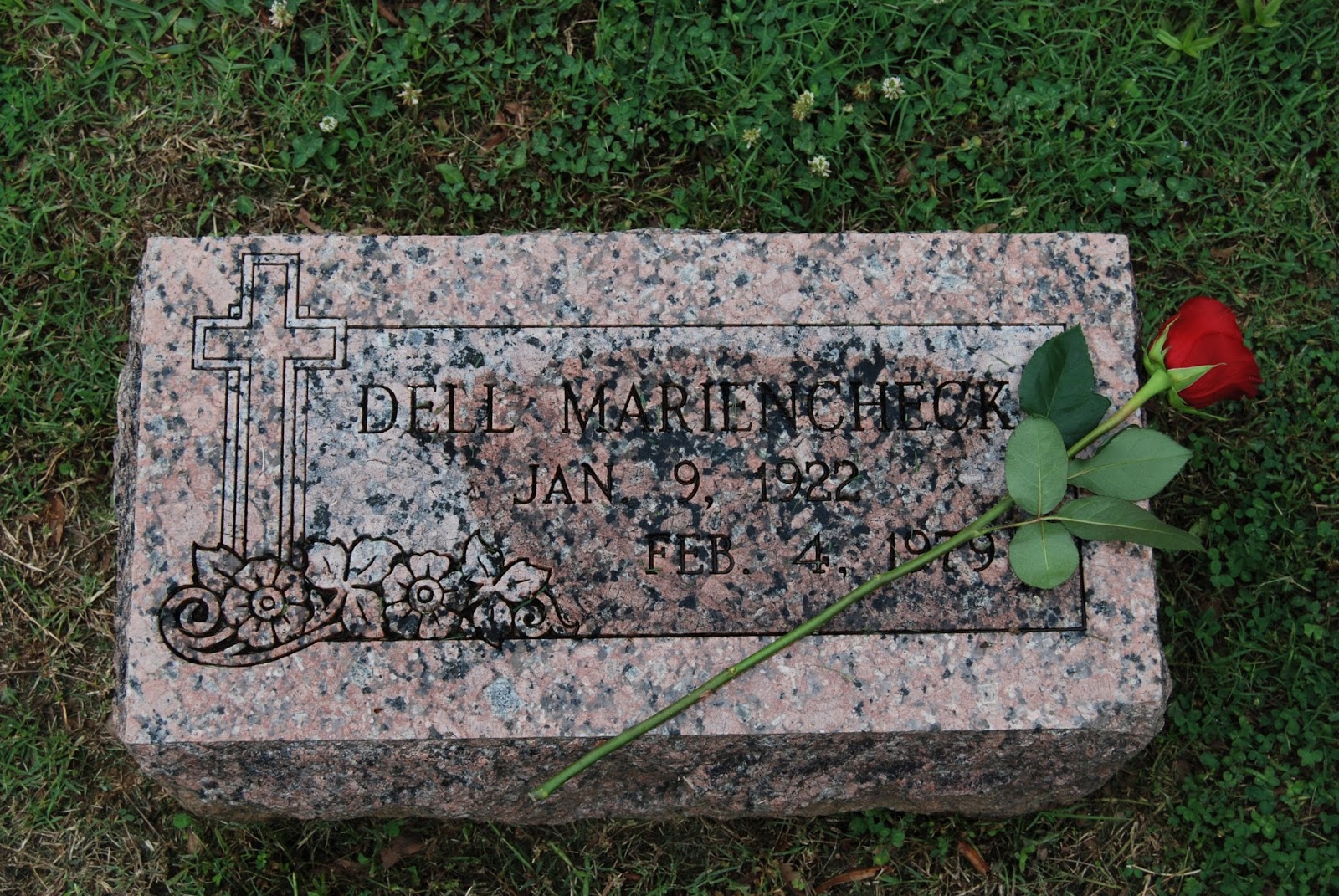
| Audele Grace Ferrer Audele Grace Ferrer was born to Olin Ferrer and Agnes Grace in 1922. She attended Blessed Sacrament grade school alongside her future husband, George “Buddy” Mariencheck. They chose different high schools; she went to Catholic (now Immaculate Conception), he went to Christian Brothers. But by 1941, when Dell was only 19 years old, they were married. That same year, they also bought their own home – an adorable two bedroom on Baltic Street. Because they were both underage (21 was the legal age at the time), they had to go before the courts and be declared adults to complete the purchase. At the time, this was such a big deal, it was written about in the newspaper! During World War II, Dell worked as a clerk at Sears & Roebuck, but she quit in 1945 before her first child, Tom (George Thomas, Jr.) was born. Over the next few years, missed developmental milestones and a variety of symptoms lead to a Cerebral Palsy diagnosis for young Tommy – likely the result of a ridiculously long labor. So Dell spent her time caring for Tom, and for her daughter, Joyce, and second son, Gary. When she wasn’t running her household, Dell loved to socialize! Her daughter, Joyce, remembers that every Thursday night was “Date Night.” No matter what! Whether it was just the two of them, or they met up with friends or family – if it was a Thursday, they were out on the town. She also loved to read. “Mamma was always riding me about the joy of reading!” said Joyce.
Tragically, an unknown allergy took Dell from her family far too soon. In January of 1979, she developed a head cold she just couldn’t shake. When over-the-counter medicines failed to offer relief, she visited her doctor, who prescribed ampicillin, a broad-spectrum penicillin used to treat bacterial infections. Her body reacted violently; after only a few days, she was admitted to the hospital and within a week, the ICU. She passed away on February 4th surrounded by her family. |
|


| Personal Data | Tombstone Data | ||
| Birth: | 9 Jan 1922 | City: | Memphis, TN |
| Marriage: | 1 Sep 1941 to George Mariencheck | Cemetery: | Calvary |
| Death: | 4 Feb 1979 | Section: | |
| GPS: | |||
Thursday, May 23, 2013
The Case of the Prisoner Produce
| Brother: Granny told me there was a prison right down the street from her house. Sister: What?! No there wasn’t. Brother: Yes there was! The prisoners used to give her vegetables through the fence! Sister: You’re making this up! All that was near Granny’s house was other houses! I remember! Brother: You are dumber than a stick. Sound familiar? There’s nothing better than a randomly sparked family history memory. When they’re verified by other members of the same generation, it’s easy – a few quick checks and you can publish the story as fact. But when family members disagree, the real fun begins. Fact checking is upgraded to full-on research. Interviews are conducted with neutral cousins. Maps are consulted. So it was for the Case of the Prisoner Produce. Gary Mariencheck claimed that his grandmother, Agnes Grace Ferrer, lived near a prison and used to get produce through the fence from the inmates. His sister, Joyce Mariencheck Klinck, disagreed. ... And the winner is: Gary! Prior to 1929, the County Workhouse was located on Jackson Avenue. The property backed up to Holmes, where several of our ancestors built homes in about 1922. The workhouse itself was in the vicinity of the southwest corner of Jackson and Macon in one map. In another (shown), it faces the northwest corner of Homes and Guernsey Ave. The property included an old County Hospital and Insane Asylum. As the years went by and more and more county land was absorbed into the city limits, the facility moved and the existing land was parceled out into the regular neighborhood that exists in the 1950-born memory of Joyce. Also, according to Vincent Clark, archive specialist at the spectacular Shelby County Archives, the workhouse did indeed grow their own food. “Though they ate what they produced, the excess was sold off and went toward the support of the prisoners.” … and according to family lore, to the support of Agnes Grace Ferrer! |
|

 | |
| In this 1938 map, the prison is labeled both as "Shelby County Hospital and Poor Farm" and as "Workhouse." The three red perimeters on Holmes street show three adjacent family properties: 1028 (bottom) was the home of Edwin Booth Grace (et al), 1034 (center) was the home of Harry Doyle and Bertha McKee (et al), and 1038 (top) was the home of Gertrude Grace and her daughter Agnes (et al). The red perimeter of 3307 Lamphier shows the home of Tom R. McKee (Gertrude's brother). |
Wednesday, May 22, 2013
What's Your Name?

|
This photo came from the collection of Agnes Grace Ferrer. The inscription on the back reads, "South Speedway. May 7, 1916." Unfortunately, we can't find anything called "South Speedway" and there doesn't seem to have been any big "to-do" in Memphis on May 7. But what if this isn't in Memphis? The two ladies to Olin's left are a mystery. Are they his sisters? The youngest child (standing on the siderail) is probably Joseph Grace. He was 2 in 1916. We believe his mother, Lillie, is on the far left. All others are currently unknown. 1. Lillie Brown Grace 2. Unknown 3. Unknown 4. Olin Ferrer 5. Joseph Grace 6. Unknown 7. Unknown 
Do you know who this is?
|

Wednesday, May 1, 2013
What's Your Name?
 |
What I know: This photograph is from Joyce Mariencheck Klinck's collection. Although we've posted a list below, there's a lot of uncertainty. #1 is identified as Donnie Grace, but #8 could be Donnie as well. We identified #3 as Dell Ferrer Mariencheck based mostly on age; but without a lot of pictures of her as an infant, it's tough to be certain. Finally, for #6, Joseph Grace is the most likely candidate (again, based on age) - but we have no photographs of him with this many freckles, so this identification is highly suspect also. Special thanks to Maggie Grace Murphy for her help with this one!
Do you know who these children are? |
||
 |
|

Tuesday, May 3, 2011
George Washington Ferrer
b. 15 Mar 1850
m. 7 Dec 1886 d. 3 Sep 1898 |  |

George Washington Ferrer was born in Georgia, March 15, 1850. His father was a minister in the Baptist church. Thus the godly training of both father and mother made deep impressions upon him while yet a child, and at the early age of seven years he professed relition and united with his mother's Church. After leaving home, and when about the age of twenty-five, he left the church of his early choice and united with the Methodists. He was licensed to preach in 1884, and the same year was admitted on trial in the Alabama Conference.
Where

When

Subscribe to:
Comments (Atom)